My Top 4 Copywriting Hacks: Tips From a Professional Copywriter
Let’s cut right to the chase – writing copy for your brand (any kind of copy, really) can be majorly taxing on your brain. This is especially true if you don’t have a copywriter’s background.
But take it from someone who has been a professional copywriter since 2016 (that’s me! hi!) – writing words can be hard, no matter how much experience you have.
Whether I’m working on my own copy or a client’s copy, I sometimes find myself reaching for what to say, how to say it, or who I’m saying it to.
That’s just how our brains work! But what I have figured out over the last decade is a few quick hacks to bypass those brain freezes and nip writer’s block in the bud so that I move past the freeze-up and get back to writing words that do their job!
And today, I’m sharing my fave professional copywriting tips and hacks to help you write better copy faster.
THIS BLOG AT A GLANCE: LIL KEY TAKEAWAYS
Writer’s block isn’t a talent issue, it’s a process issue (fix it with the Bad Words Doc™)
Messaging gets easier when you stop overthinking it and use simple frameworks (hi, 4 Ps + Get-Who-Need-To-By)
Your brand voice should be trackable, repeatable, and buildable (enter: your Brand Voice Dictionary)
Consistency is what makes your voice stick (not just creativity)
The faster you get out of your head, the faster you write copy that actually connects
A Professional Copywriter’s Top 4 Copywriting Hacks for Writing Better Copy
Copywriter Hack #1: Bad Words Doc
Let’s kick things off with the world’s most practical tip: The Bad Words Doc™.
A Sneak Peek at This Copy Hack
WHAT THIS HACK SOLVES: The “I’m stuck!” freeze-up (or what’s commonly called writer’s block) – it keeps all your ideas in one spot without taking up extra space in your brain
WHAT THIS HACK IS: A separate Google Doc that’s home to all your phrases, words, taglines, or ideas you come up with so it doesn’t have to live on your page
WHY THIS HACK WORKS: Our brains don’t always love to multitask (generate ideas and judge ideas / create ideas and edit ideas) – this separates the process and frees up RAM in your head.
Here’s the reality of being a human being: sometimes we get SO caught up on a phrase or a word or an idea that we simply cannot let it go.
Even if it’s not a very good word, phrase, or idea. But because we can’t let it go, we don’t give our brains the space needed to think up more (better!) words or phrases or ideas that could help connect with our people. Our brains are truly incredible, but sometimes it’s like we have limited RAM (space) in our heads.
And because we’re so afraid to let that old idea go (because what if it actually IS the one?!) we can’t actually come up with any other words.
When we’re writing, our brains are trying to do 2 things simultaneously:
Generate Ideas
Judge Ideas
We’re supposed to create and edit all at once, but we don’t always do a great job of that. Let’s say you create a tagline for a new offer. You can tell it’s not THE tagline, but it could be edited to work better.
Here’s how the problem starts:
You want to try other ideas
But you don’t want to forget that idea
Your brain holds onto it and brainstorms
But you end up spiraling because you can’t hold onto it and brainstorm
So then you get stuck. Then that OG idea loops and repeats forever in your head until you get so frustrated that you just ask Claude or ChatGPT to do it for you.
My solution for this? Enter: The Bad Words Doc™
It’s just an extra Google Doc or Word Doc you open up next to whatever doc you’re working on.
This doc has a very specific job – it’s going to be your dumping ground for every idea you end up with – good or bad.
Instead of wasting mental energy holding onto bad ideas just in case you might want to revisit them later – release the pressure by writing them down in your Scrap Doc. That way, you can keep all the stuff your brain throws out there without wasting mental energy holding onto bad ideas that could be keeping you from good ones.
I feel so passionately about the Bad Word Doc, I wrote a step-by-step blog for you (which you can take a peek at right here)and put together a quick reel for you to watch (for my visual learners out there).
Copywriter Hack #2: Make Messaging Easier with Brain Shortcuts
If you’ve ever sat down at a blank screen to write something for your brand but had absolutely no idea what to say or where to start, it’s probably because you’re trying to create words out of thin air.
Instead, you could brainstorm a few messaging points (the What Stuff) for your brand or your offers – then refer to those messaging points every time you want to talk about your brand or your offers.
The problem? Messaging gets a bad rep because we tend to overcomplicate it. These messaging hacks can make writing (and creating your messaging) so much easier.
A Sneak Peek at These Copy Hacks
WHAT THESE HACKS SOLVE: All the moving parts and scattered ideas messaging by zeroing in on the elements that matter most (the What Stuff)
WHAT THESE HACKS ARE: Quick frameworks and brain exercises to run through when figuring out your “messaging” feels hard.
WHY THESE HACKS WORK: They uncomplicate messaging – an element of marketing that seems to spook us all. When we know what to ask ourselves, we can figure out the answers – these frameworks help cut the noise and narrow down what we need to be thinking about, as well as show us how to reframe these messaging points to matter.
My main messaging hack is actually a few quick brain exercises all designed to help you shake up the way you think about messaging points.
The quick overview before we dive in too deep. Messaging is the what stuff – what you’ll say about your brand or your offers. A messaging guide is just a collection of messaging points about those things. It’s what you’ll say and who you’ll say it to.
Coming up with those messaging points can trip our brains up. These four shortcuts can help you nail down your messaging points fast!
Here are the three main shortcuts I love to uncomplicate messaging:
The 4 Ps of Messaging: This hack helps you cover the main points of a messaging guide – People, Problems, Promises, and POVs. Zeroing in on these four main elements of messaging can help you cut through the clutter and get to the good stuff.
Get-Who-Need-to-By:There’s so much we could say about our offers that it can feel impossible to zero in and say the things that matter. This framework sets you up to ask and answer the basic questions so you can get to the root of your messaging. Write out this framework and fill it in
GET: (Who’s your audience?)
WHO NEED: (What are they craving or desiring?)
TO: (What specific problem are they looking to solve?)
BY: (What transformation does your offer provide?)
The Power Of Why Hack: Messaging gets hard when we’re too close to what we’re working on. Being an expert is great – but usually it means we’re too far away from the problems our people (who aren’t experts!) are actually dealing with. And messaging is all about figuring out how to reach our ideal people. You need to speak their language again. The 5 whys framework can help you do that!
List the problem you think your people are dealing with
Step 1: Ask why. Answer that.
Step 2: Ask why. Answer that.
Step 3: Ask why. Answer that.
Step 4: Ask why. Answer that.
Step 5: Ask why. Answer that.
Now list the problem you worked your way down to – the one your people are actually dealing with!
Want a peek at a full blog on all those shortcuts? I’ve got you covered right here!
And if you really want help brainstorming messaging points that connect with your people, I highly recommend Mini Messaging Marker – my 12-min training that helps you figure out what to say about your latest and greatest thing!
Copywriter Hack #3: Pay Attention to Your Personality & Track It – The Brand Voice Dictionary
A Sneak Peek at This Copy Hack
WHAT THIS HACK SOLVES: Not knowing what your brand says or thinks that makes you different, sticky, and compelling! It helps you track and repeat your personality!
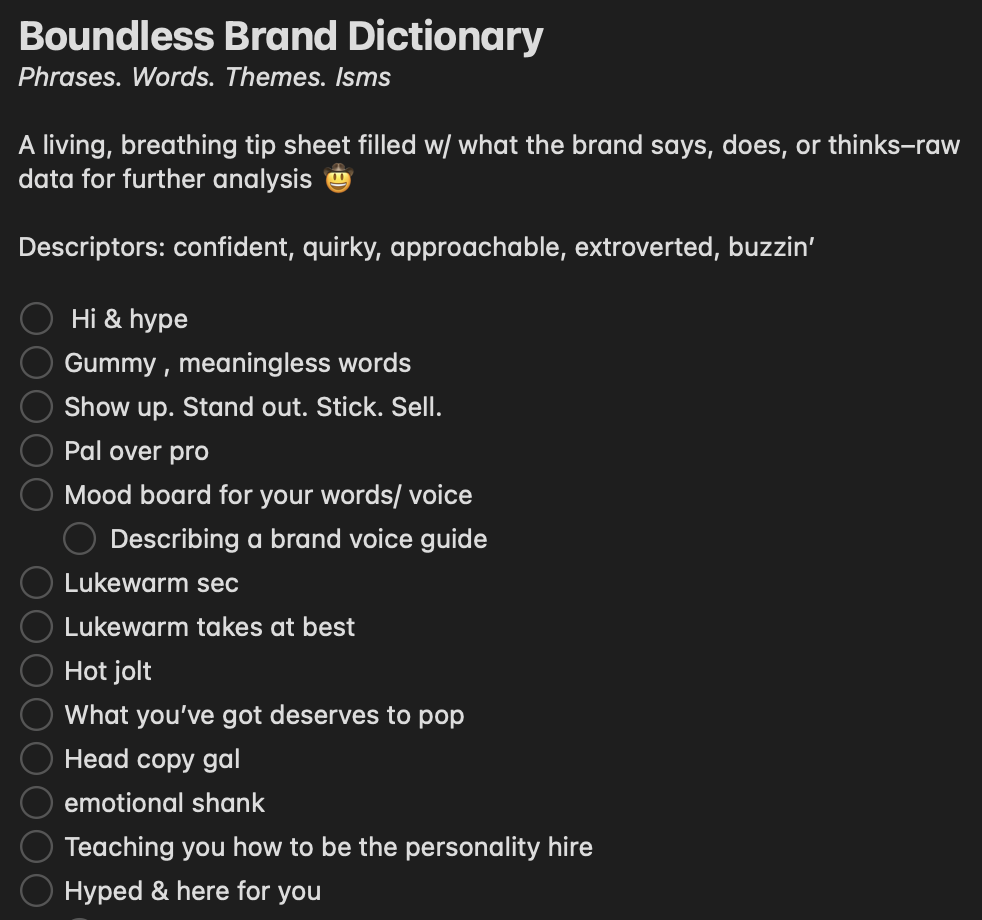
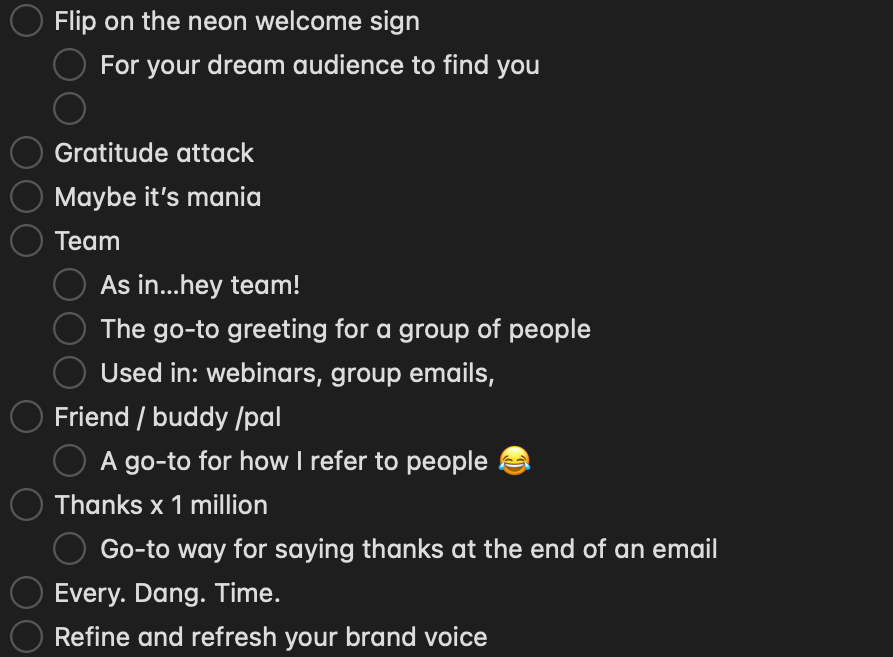
WHAT THIS HACK IS: A living, breathing tip sheet you continuously update, filled with your go-to words, phrases, ideas, and isms!
WHY THIS HACK WORKS: It takes the confusion and chaos out of tracking your personality and gives you the ability to create consistency in your brand’s vocabulary!
One of the biggest issues in writing your brand’s copy is it sounds generic – like anyone could have written it. That’s why sticky brand voice is such a huge part of writing great copy.
You already know that your brand's words should do heavy lifting – but if you have no idea how to bring personality, pizzazz, or pep to the table, the copy you spend so much time on will probably just dissolve into the digital world of words (especially if you’re in a crowded industry!)
Knowing what to say (like with your messaging) is the first step – knowing how to say it is the next. That requires paying attention to your personality, knowing what sets your voice apart, and then repeating it consistently so your people can start to recognize you wherever you show up.
But how do you do that?
A Brand Voice Dictionary is basically a living, breathing tip sheet for you to track your brand’s words, phrases, and isms! It’s a go-to guide you can pop open so that you can crush consistency every time you start writing. Here’s a quick look at some of mine! (Note: it’s a living sheet, so this changes – and it’s several scrolls long!)
Here’s a step-by-step guide on how to set yours up!
STEP 1: Open up a note on your phone / in a Google doc (wherever you’ll actually add to it)
STEP 2: Title it [Your Brand Name] Brand Voice Dictionary
STEP 3: Start paying attention to yourself. When you’re talking to a client you work well with, when you’re on a call, when you’re emailing & it feels natural–just pay attention!
STEP 4: Write it down. Without judgment, without strategy. Just start writing–that funny thing you said to a friend, your regional slang you use all the time, a phrase your kids tease you for that you’ll never let go, a sentence you find yourself repeating to clients all the time.
STEP 5: Take a peek at what you’ve added. Which of these words and phrases align with the feeling of your brand voice that you discovered in your Voice Venn Diagram?
STEP 6: Enjoy the process and keep adding to this without pressure. This is a living, breathing, and evolving note that’s meant to flex and change.
Copywriter Hack #4: Make Your Sticky Brand Voice Easily Repeatable
Speaking of sticky brand voice – it goes so much further than just the vocab behind your voice. To create a truly sticky voice, you need to refine ‘n’ refresh yours – to figure out what makes it special, different, compelling, and unique!
Doing the diggin’ on this is the first step! Creating a usable, go-to guide that you can pop open every time you write (aka a brand voice guide!) is the next. As a professional copywriter, I consider this is THE most important hack for brands out there.
Your sticky brand voice is like a neon welcome sign on a crowded desert highway – even if there are other brands like you out there, it’s your unique voice that’s going to stop your ideal client in their tracks when they hear it.
A Sneak Peek at This Copy Hack
WHAT THIS HACK SOLVES: Un-freezes you when you wonder how to say something like your brand. It fixes your “this sounds like anyone could have written it?!” issue fast.
WHAT THIS HACK IS: A go-to guide you can pop open and use every single time your write something for your brand so it’s consistent across platforms.
WHY THIS HACK WORKS: It makes sure everything you write is deliberately your brand’s. It creates a consistent, credible identity that your people can connect with, trust, and bond with.
Want to learn how to create your own brand voice guide – and actually use it? Check out my mini course, Brand Voice Roundup, that walks you through the process of building your custom brand voice guide, then teaches you how to use it every time you write!
Want to Write Better Copy? Professional Copywriter Help is Here
The good news? You don’t have to tackle this world of words alone! As a professional copywriter, I’m here to help! You can work with me to get strategic, personality-packed copy written for you – or learn how to do it yourself with my trainings and resources designed to make messaging finally click.
Not quite ready for that? I’ve got plenty of free copy tips and resources waiting for you on the blog and in my newsletter The Hey Pal Club, plus behind-the-scenes, helpful hot takes, and actionable tips over on the ‘Gram.
However you want to get there, there’s a next step with your name on it – go take it!