What to Include In Your Brand Voice Guide: A Professional Copywriter’s Tips
Having a brand voice guide for your business is a smart, important marketing move – but not if you can’t use it.
If you’re currently in possession of a brand voice guide that’s all vibes and no values, I ask you outright – what’s the point of having it?
I know so many business owners out there who have some version of a brand voice guide that just sort of sits in their brand guideline docs and collects dust. They never use them…because they’re pretty useless.
I’m a big believer in brand voice guides, but only if they’re actually helpful when you pop them open. The whole point of a brand voice guide is to save you time and effort, and help you with your brand’s consistency.
But if your guide isn’t giving you any answers, is more confusing every time you open it, and sort of just sits on the sidelines – it doesn’t have what you need inside it.
Your brand voice guide should give you actionable steps on HOW to use your brand voice. It should answer big, important questions about your brand and why it is the way it is. It should give you key insights and reminders about who your ideal people are and how to talk to them.
In this blog, I’m sharing all the details on what I think should land in your brand voice guide so that you can start building one that you can actually pop open, use, and love.
LIL KEY TAKEAWAYS: THIS BLOG AT A GLANCE
A good brand voice guide should actually help you write, not just collect dust in your Google Drive
Your brand voice is more than “vibes” – it needs actionable steps, examples, and real direction
Consistency is what makes your brand recognizable (and recognizable brands get remembered)
Your guide should answer big questions about your people, your personality, and your overlap
A Brand Voice Dictionary is basically your cheat sheet for sounding like YOU every time you write
Visuals, playlists, phrases, screenshots – if it helps you tap into your voice, it belongs in your guide
You shouldn’t have to reinvent your brand voice every time you write a dang Instagram caption
Brand Voice Guide 101: An Intro to Voice Guides
What is (Sticky) Brand Voice?
I won’t take up too much of your reading attention span with this, but if you’re not super familiar with sticky brand voice, I encourage you to read this entire blog on sticky brand voice 101. If you’re not ready to jump into a totally different blog and want to keep this thought training going, I hear you. I’ve got a quick bulleted list of what you’ve gotta know about brand voice before you go forward.
Brand voice is HOW you show up and talk as your brand. If messaging is what you’re saying, brand voice is how you’re saying it.
Brand voice is the consistent & curated personality, vibe, & attitude of your brand when presenting itself to the world.
Brand voice should be the sweet little intersection between who you already are and who your ideal people need you to be. Basically, it’s you – but you at your absolute best. It’s important that you understand when I say “best,” I don’t mean “most professional” or “most sophisticated” – by best, I simply mean the version of your personality that best connects with the people you want to work with.
Brand voice is more than just a “vibe” – it’s actionable. Your brand voice should have a personality and “vibe direction” (maybe you’re effortlessly cool or no-nonsense or chatty), but it should also have real guidelines and a dedicated dictionary full of your brand’s particular words and phrases.
Brand voice should be consistent and recognizable – that’s what makes it sticky. It’s not enough to just curate your brand voice; you need to use it at every turn and opportunity so that people can truly start to recognize you. That’s what sticks with them. I highly recommend creating a brand voice dictionarywhere you can track your brand’s words, phrases, themes, and isms, then open it up and use it every time you write something.
What is a Brand Voice Guide?
A brand voice guide is just a go-to document that instructs, guides, and reminds you what your brand voice should sound like and inspires at every touch point.
You know how you have visual guidelines for your brand so that you know what colors, fonts, and logos to use everywhere? You lean hard on this so that your brand is visually consistent at every touchpoint. If you didn’t use it, you’d have 14 shades of orange floating around the internet, all kinds of weird fonts, and a few different versions of logos.
That visual guideline keeps you consistent, aligned, and clear – so that your brand looks the same everywhere and so your audience can recognize you everywhere.
That’s the exact same idea for your brand voice guide. You have a go-to guide that instructs you on how you talk – that way, your voice is consistent, your brand sounds the same everywhere, and you’re instantly recognizable to your people.
Why You Need a Brand Voice Guide
If you’re a business owner or someone in charge of running a brand, you need a brand voice guide.
Most things in life and business aren’t that cut and dry, but this one (thankfully) is.
A brand voice guide isn’t a “nice-to-have” luxury; it’s an incredibly important tool that’s going to help your brand with consistency, trustworthiness, and recognition.
Why do those things matter? Because all of them directly impact your ideal client’s probability of investing in you.
Here are a few very quick, but very hard-hitting, reasons you should have a brand voice guide:
Without one, you’re always guessing and grasping at your brand’s voice: In a dream world, you wouldn’t have to guess or go digging every time you write something to try to remember “how you say that” or “how you talk about that.” In a dream world, it’s all in one place. You rely on visual brand guidelines for the same reason (logos, fonts, color palettes, etc.), so why wouldn’t you do this for your brand’s voice?
You can pass off more work and responsibilities without sacrificing brand consistency: It’s likely you don’t want to handle every element of your brand’s communication forever. Eventually, maybe, you’d like to pass off social media, emails, blogging, website copy, etc. to someone else to manage. How can you ensure that they’re following your brand’s voice guidelines if you…don’t have any guidelines to give them? Consistency and continuity become a lot easier (and you can rest easier, too), when you have a brand voice guide to hand off to your team.
It makes writing EVERYTHING faster and easier: Writing is hard enough. Writing for your brand’s voice is even harder if you don’t have a guide to lean on. You shouldn’t have to start from scratch every time you sit down to write an Instagram caption, an email, or a sales page. This is the ultimate shortcut to help you write in your brand’s voice without having to scrape together details every time.
It creates consistency, which creates recognition, which creates trust, which creates sales: The more consistent you are, the more recognizable you are. The more recognizable you are, the more likely people will trust you. The more people trust you, the more likely they’ll give you a shot and invest in you. It really does all trace back to a consistent, recognizable brand voice.
I could go on, but I do think those four reasons are compelling enough to leave you wondering why you don’t have a brand voice guide in your brand guides yet.
Building Your Brand Voice Guide: What Should Go Inside
Just like everything in business, there’s no rulebook for your brand voice guide.
This is super subjective – you can Google this question and end up with, like, 1,000 different answers on what belongs in your brand voice guide.
As a brand voice strategy expert, I’m going to share exactly what I think you should include in your brand voice guide so you can actually open it up and use it.
I’ve spent a decade helping brands put their guides together so that I can hand them off and know that they can open them and use them on a daily basis – and that it would actually make their lives easier.
That’s the caveat for this list – there’s no fluffy stuff here. I’m only including elements that I know will make your guide actually usable and helpful. (Which is the whole point to begin with!)
The Groundwork: Answers to the Big Important Questions Section
Who Are Your People?
You can’t find that sticky sweet spot of who you are and who your people need you to be if you don’t actually know who your people are and what they’re looking for. This isn’t just about naming your “target audience,” giving them an age demographic, and being silly about what music they listen to.
You’ve got to get real. You’ve got to ask and answer questions like:
What do they need in a pro like you? Like what do they really need?
What issues are they actually struggling with? (Not just what you think the issue is).
What do they really want? What’s standing in their way?
What’s the real transformation they’re looking for? What’s their “before” and “after” look like?
You need to know who your audience is and what they’re after to eventually get to that Sticky Overlap section I’ll talk about in a sec.
What Do You Want to Inspire People to Do When They Interact With You (Beyond Book or Buy)
I think every business owner should think so seriously about this. This is about what goes above and beyond the services you offer – and it contributes so much to your brand voice.
What’s the inspiration you want to leave your people with after every interaction with you – whether they book or not with you?
What do you want to inspire them to do after a single interaction with you – even a fleeting one?
Roll with me on this.
Let’s say you’re a fitness coach. Sure, you want to inspire them to book a session with you, but do you also want to inspire them to confidently hit their PRs? To hike a mountain without having to stop? To be able to lift their grandkids?
This question is about figuring out what you want to inspire in them – it’s about inspiring your ideal audience to see the transformation that’s available to them through you.
Personally, more than anything, I want to inspire my people to be hyped about their own brand again. To be refreshed and reinvigorated by their own brand again.
What’s the inspiration you want to leave them with at every touch point? That’s a big exciting question you need to answer – because how you talk is going to play into that.
The Tone Keywords Section
We’ve all seen those brand voice guides that are like, “Your brand sounds effortlessly cool!” or “your brand sounds professional but not stuffy.”
And those vibe-y answers to describe your brand’s voice are sort of fun, but not usually very helpful. Because how do you sound effortlessly cool? How do you sound professional but not sterile.
Here’s what makes those types of sections actually helpful.
Yeah, identify those keywords till you’re blue in the face – but also include examples of words or phrases that you use, have used, or want to use to get that feeling across. If you’re going to include a “tone keyword” section to describe your voice, always include direct examples of what that looks and sounds like to you – that way you have a visual example!
The Sticky Overlap Section
Remember how I said sticky brand voice is the beautiful little fusion of who you already and who your people need you to be? Figuring out how to tackle that starts with The Overlap.
To find that overlap, you need to make a venn diagram.
On one side, write “Who I Already Am.” On the other, write “Who My People Need Me to Be.”
Then brainstorm each side. Name some personality traits, describe your voice, list things that you like (or even don’t like) about who you already are and your personality. Then, tackle the other side – answers you should already have if you tackled that “big, exciting questions” thing I talked about.
Then, find what overlaps, and write it down in the middle.
That’s The Overlap.
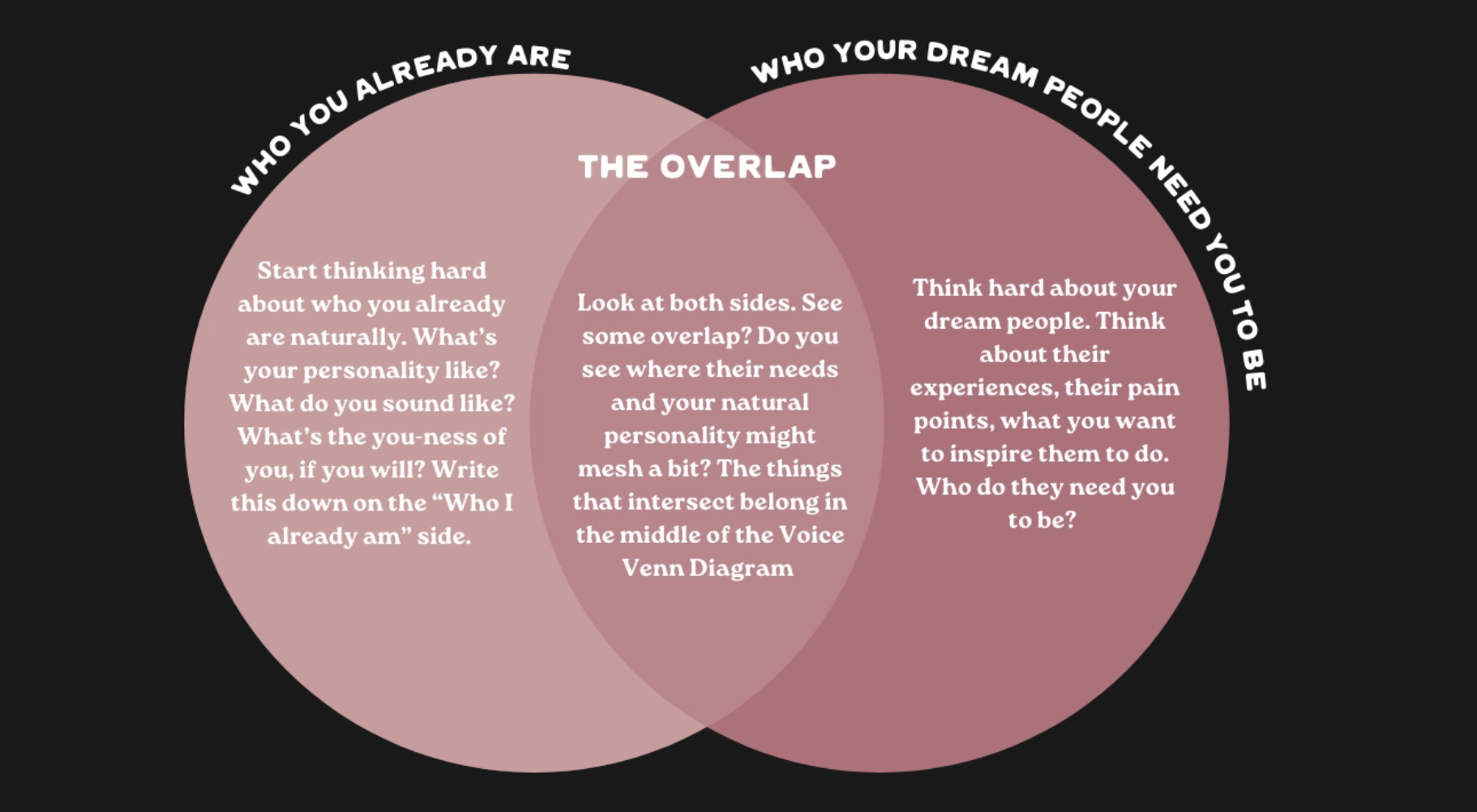
Take a peek at that image above this line.
When I was digging deep into my own “target audience,” I realized that I despeartely wanted to work with people who knew they needed a copywriter but either hadn’t worked with one before or had a bad experience with one before.
They wanted a copy professional, yes, but they also really wanted a copy pal.
That’s where my own overlap comes into play – I’m already approachable, friendly, and outgoing. My kind of people are searching for someone they can trust and talk with – without being intimidated.
See that overlap?
That’s why knowing who your people are and what they need is such an important first step.
The Voice Visuals Section
This section is incredibly helpful for creative folks. Don’t get me wrong, I know a few business owners who never lean on this section of their brand voice, but overwhelmingly, this section is the ticket that gets business owners INTO their own brand voice.
Your brand voice is more than just words on a page – it’s a feeling. And more importantly, it’s how people feel when they hear you talking. We all have primitive brains that, despite logic and reason, activate and make choices based on how we feel. And that’s supremely human and personally, I love it.
What that means is, from a connection standpoint, you need to make sure your people feel GOOD when they hear you. You need to curate a vibe that hits ‘em in the feels.
But if you can’t describe the vibe of your voice…how could you ever expect your people to get it or click with the vibe. You need to know the vibe first.
The problem is: I could sit up here and tell you to outline your brand voice archetype in a paragraph–but that’s how my brain works. That’s how I find the vibes. Straight through words.
We all learn and relate to things differently, and we all find clarity in our vibe and ways to illustrate how our voice feels differently.
So, it’s helpful to have a section that’s visual or audible – something that helps you channel your own vibes.
That could be anything that makes sense to you – an outfit that IS the vibe of your voice, a playlist that gives off the vibe of your voice, the way a room is decorated, a snapshot of a vision board, a piece of art that you feel like reflects your voice.
Whatever it is, it only needs to do one thing for you – when you look at it or hear it, you need to say “hell yeah, that’s how my voice feels.” And I don’t need you to put it into words, it just needs to emit a feeling that puts you in the place to write in your voice.
Personally? I’ve got a Boundless Copy Brand Voice Playlist I turn on anytime I’m struggling to write in my own brand voice. Peep it below.
The Brand Voice Dictionary Section
To be consistent, you need a go-to guide for your brand’s lingo. Whether you know it or not, you have a whole curated vocabulary that are telltale signs of you-ness.
Creating your own Brand Voice Dictionary – a living, breathing tip sheet filled with what your brand says, does, or thinks – that you can pop open every single time you’re writing is so clutch to make sure you’re being consistent with your language.
Here’s some quick directions on how to start yours! Remember, a Brand Voice Dictionary is a living, breathing tip sheet – it’s going to evolve and change!
The Samples & Examples Section
Every brand voice guide should have a section dedicated to some of your best work – and by best work, I mean samples of things that feel like the best version of your band voice.
Instagram captions, emails, lil phrases or words – if you loved something you said, it belongs in the samples and examples section so you can emulate that time and time again.
Plus, if you’re ever in a slump – you can pop this section open for inspo (instead of scrolling through your whole IG feed wondering where that caption was that you were so proud of).
The Actionable Steps Section
Any brand voice guide worth its salt should have a step-by-step section that reminds you how to use your brand voice. Your guide is worthless if it’s not something you can pop open and legitimately follow along with to write in your brand voice.
In my mini course that teaches you how to build and use your own brand voice guide (Brand Voice Roundup!), there’s a section called Active Voice that shares a step-by-step list for using your brand voice. That way, you can pop it open and implement it every time you write.
Your Sticky Brand Voice Guide Can Happen – & Boundless Can Help
Your brand deserves to stand out, shine, and sell. But your sticky voice needs to be able to do its thing so it can land with the audience of your dreams. Enter: your brand voice guide.
If you’re struggling to create a brand voice guide that you can use consistently, here’s a quick list of helpful resources you can lean on to curate your sticky brand voice, build a guide, and use your voice to stand out!
Brand Voice Basics (Free):A down ‘n’ dirty ebook that walks you through all the basics of curating and using your own brand voice!
How to Build Your Brand Voice Dictionary (Free): A quick and easy blog (or reel if you’re more of a visual learner) to teach you how to create and use your custom brand voice dictionary.
Brand Voice Bootcamp (Free):a weeklong email challenge that walks you through taking your brand voice from blaaaah to bold.
Brand Voice Roundup ($): A quick mini course that shows you step by step how to build and use your custom brand voice guide.
1:1 Brand Voice Strategy ($$): My signature done-for-you service where I curate your sticky brand voice, create your go-to Brand Voice Guide & Brand Voice Dictionary, then share an actionable checklist with step-by-step directions to show you how to use it every day.