Copy 101: How to Show Up, Stick, & Sell with Better Words
You know what I wish someone had told me when I started my business?
That eventually, I was going to spend an alarming amount of my life thinking about – and getting “good” at Instagram.
Not because I particularly wanted to or woke up one morning and thought, "wow, I hope I get really savvy at creating Instagram posts!”
But because running a business means more than just doing the thing you’re good at – it means marketing yourself and the thing you’re good at, too.
When you started your business, you signed up for a lot of things, but particularly, you signed up to spend a lot of time getting better at doing the thing you’re good at. But I bet you didn’t spend a ton of time thinking about your marketing efforts. Right?
Very rarely are new business owners thinking, “wow! I’m so glad I started this business so that I could spend my very limited free time getting good at writing copy just to justify doing the thing I’m already good at doing.”
I hate to surprise you with this, but when you started your business, you became a marketing director. And that means you have to figure out how your words help you show up, stick out, and sell to your ideal people.
And if the reality of that is cutting deep and you’re feeling stranded, lied to, and very “how the heck do I do this?”... then the good news is you’ve found the right blog to steer you in the right direction.
We’re gonna talk through a few reasons your words are so important (to provide much-needed perspective), dive into a copy lingo breakdown (just a small one, so you don’t panic when you read these words), and then I’m going to share four steps I think every business owner should take before they ever write another word again.
LIL KEY TAKEAWAYS: THIS BLOG AT A GLANCE
Surprise! You accidentally became your business's marketing director.
Being great at what you do matters, but people still need to hear about it, find it, and understand why it matters.
Copy is just words. Messaging is what you say. Brand voice is how you say it.
Start with your messaging before you worry about sounding clever or "on brand."
Strong POVs help people quickly understand why you're the right fit for them.
Your sticky brand voice is the overlap between who you already are and who your dream people need you to be.
A Brand Voice Dictionary is one of the easiest ways to make your personality more memorable.
Consistency is what makes your words stick with people long after they've stopped scrolling.
Better copy helps you show up confidently, stick with your people, and sell your stuff without feeling weird about it.
Why Words? You Need to Care About Copy for These Reasons
Now that I've delivered the (very) devastating news that you're secretly a marketing director for your brand – surprise! – let's talk about why your words matter so much in the first place.
Look, I know what you’re thinking: "It doesn't matter if I know how to write. I'm REALLY, really good at what I do."
I get that – it’s a fair sentiment.
Maybe you're a ceramic artist who can throw the most beautiful mugs I've ever seen. Maybe you're a jewelry maker who spends hours perfecting every tiny detail. Maybe you're a photographer who can capture moments in a way that makes people cry.
Being exceptional at what you do absolutely matters.
But there's a hard truth about running a business that a lot of us learn the hard way: being good at what you do doesn't automatically mean people will find you.
It also doesn’t automatically mean that…
Someone will hear about you
Someone will know your product or service exists
Someone will land on your Instagram page, website, or market booth and instantly understand why you're the right fit for them
Let’s face it, pal. The internet is a weird place.
It's loud. It's crowded. It's busy. And what’s most intimidating of all is that it's constantly demanding everyone’s constant attention.
Every day, your ideal customers are scrolling past thousands of photos, videos, businesses, creators, and advertisements. They're making split-second decisions about what deserves their attention and what gets ignored.
Which means it doesn't work to simply be a person who makes a phenomenal thing anymore.
You have to be a person who makes a phenomenal thing AND can communicate why that thing matters.
That's where your words come in.
Your Words Can Seal the Deal or Slam the Door
A surprising amount of what makes or breaks a business comes down to three simple things:
how well you communicate
how well you get people's attention
how quickly you can help someone understand that you're exactly who they've been looking for
And the thing is, we get opportunities (some huge and some microscopic) to do that every single day.
Every Instagram caption is an opportunity to share your personality. Every product description is an opportunity to highlight what makes your work special. Every email is an opportunity to build trust.
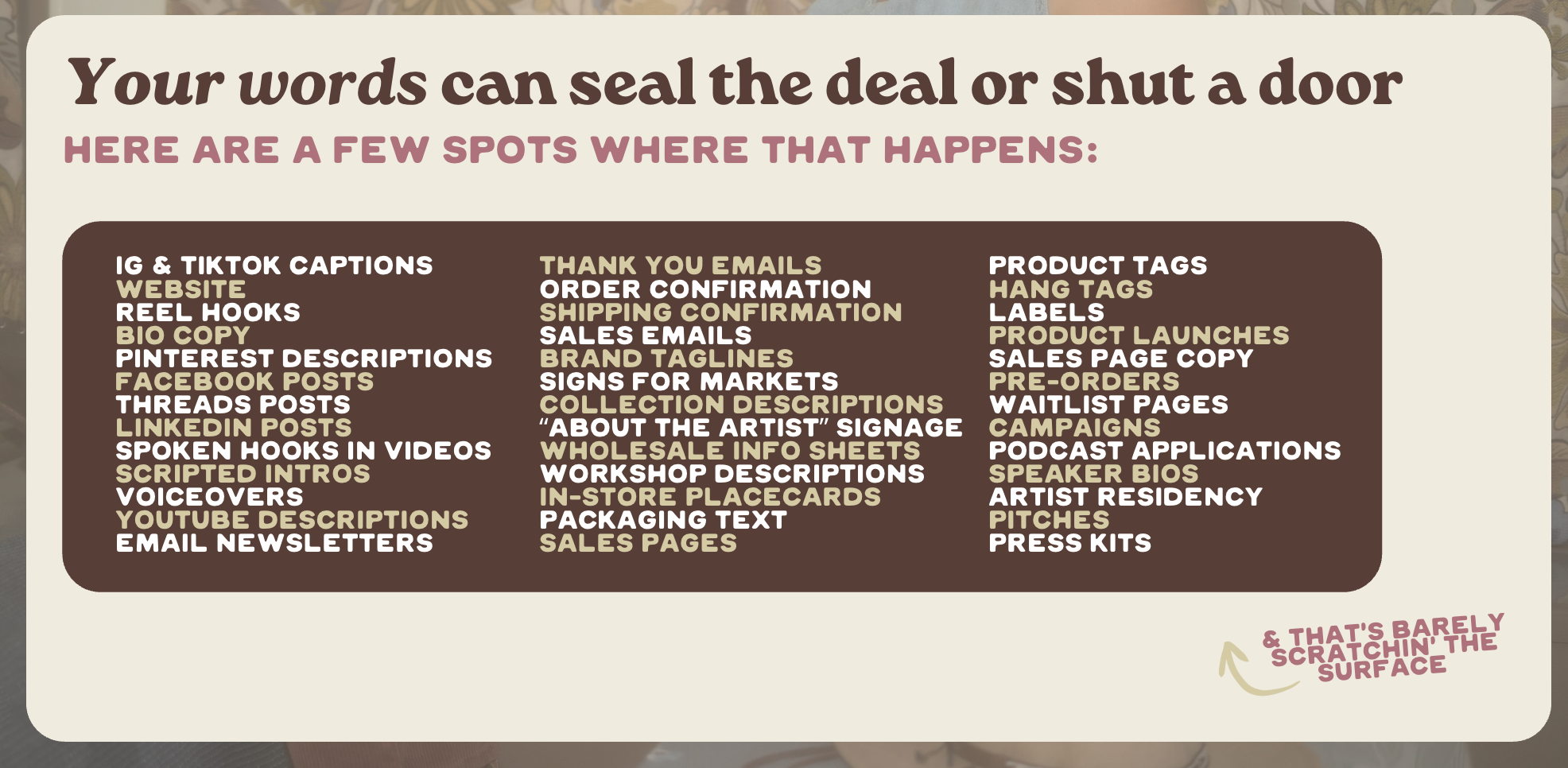
As a fun exercise, I set a timer the other day for 90 seconds and tried to come up with an exhaustive list of everywhere your words (as a business owner) show up and make a difference. That image right above this paragraph IS that list – except it’s only a fraction of the place I came up with.
The point is that your words are everywhere.
Whether you're thinking about them intentionally or not, your copy is constantly helping people form opinions about your business. It's helping them decide whether they trust you, whether they like you, whether they're curious about what you're doing, and whether they want to stick around long enough to learn more.
That's a pretty big job for a few words.
The good news is that when you start understanding the weight of your words and fine-tuning them, the payoff is huge.
When you get a handle on your words, you can do a few things much better:
Show up confidently in a crowded and saturated online space because you know exactly what to say and how to say it. Instead of staring at a blinking cursor and hoping something brilliant appears, you can trust yourself to communicate clearly and consistently.
You also get the chance to stick with your people. Your words become a vehicle for your personality, your perspective, and your values. They help people get to know you. And when people get to know you, they can start to like you, trust you, and become curious about what you're building.
You can also share and sell your stuff without feeling weird about it. Selling starts to feel a lot less gross when you're simply communicating value clearly. You're not trying to convince people they need something they don't want. You're helping the right people understand why your product, service, or offer might be a great fit for them.
That's why words matter.
Nobody handed you a rulebook for writing when you started your business. Most of us are figuring it out as we go, but writing is a huge part of running a business, whether we planned for it or not.
The better you get at your words, the easier it becomes to show up, stick with your people, and sell the things you're already working so hard to create.
How to Show Up, Sell, & Stick: Four Steps For Writing Better Copy as a New Business Owner
You get it, right? Your words matter.
Now, let's talk about what you can actually do with that information – you know, let’s take that concept and make it concrete.
Knowing your words are important is one thing, but sitting down to write an Instagram caption, a product description, a sales page, or an email and actually knowing what to do is another thing entirely.
Next time you're sitting down to write literally anything for your business, I want you to focus on three steps.
Seriously, before you sit to write another word for any platform, do these three steps first – then watch how easy it is to write something for your brand.
Start With Your Messaging
Know Your POVs
Use Your Sticky Brand Voice
Let's break each one down.
Step One: Start With Your Messaging
One of the biggest mistakes I see business owners make is worrying about how something sounds before they've figured out what they're actually trying to say.
They sit down to write an Instagram caption and immediately start editing themselves, so they pitch a fit over wording, then rewrite the opening sentence seventeen times, and try to sound as on-brand as possible.
Meanwhile, they haven't actually figured out what they're trying to communicate in the first place.
That's why I always recommend starting with your messaging.
Messaging is just The What Stuff – what you’ll say and who you’ll say it to.
It's the information you're trying to communicate before you ever worry about how it's going to sound, and before you write anything, your job is to map out your messaging so you can create a guide for yourself.
Not sure how to map out your messaging? Let’s start here.
The Basic Rules of Messaging
The first rule of messaging? Make it boring as hell. Seriously.
Messaging is not the place for beautiful writing, clever headlines, or even personality. Messaging is the facts, the basics – the boring stuff that’s going to guide you so that you know what you’re talking about and who you’re talking to.
Think of messaging like you would think of a restaurant.
You’ve sat in a dining room before, right? You’ve got the front of house staff taking care of presentation, but it’s the back of house staff (the chefs and kitchen staff) who are mapping out the entire experience with grunt work.
The back of house is where the non-polished work happens – but the front of house experience would be lost without it.
Messaging is your back of house – it's your plan, and it doesn’t matter if it’s pretty. It just needs to ensure you’ve got a clear idea of what you need to talk about.
Second, don't overcomplicate your messaging.
Messaging is really just the facts you want to communicate.
Third, think like your people instead of thinking like the expert (yourself).
You're already operating at a different level than your customers. You know more. You've been immersed in your area of expertise longer, and you understand what you do better than they do on an intellectual level.
But your job is to climb down from Expert Mountain and think about what your people actually care about. Ponder on important questions like:
What are they frustrated by?
What are they tired of?
What do they wish existed?
What do they actually want?
How to Do This On Your Own: The 4 Ps of Messaging
The fastest and easiest way I can advise you to build a quick and useful messaging guide is to focus on what I call the 4Ps of messaging.
Go ahead, try this with me. Pick a product, a service, a collection launch, an offer (anything you do or provide) and run through these questions.
People: Who is this for? Who needs it? Who wants it? Who benefits from it? Who doesn't?
Problems: What's bugging those people? What's keeping them up at night? What problem are they trying to solve?
Promises: What's the payoff? What transformation are they getting when they walk away?
POVs: What makes this different, compelling, or worth investing in?
Answer those four questions, and you'll have the foundation for messaging for everything you write.
Step Two: Know Your POVs
We just touched on POVs, but they deserve their own section because this is where most business owners get stuck.
Like I said, a POV is a thing that makes you, your offer, or your service different, compelling, and worth investing in.
In a perfect world, your ideal customer would look at your business and instantly understand why you're the perfect fit for them.
Unfortunately, that's not how people work. And importantly, if you don't know what makes your business different, compelling, or worth investing in – why would you expect someone else to figure it out on their own?
That's asking a lot.
People need those dots connected for them; they need to understand what makes your product special, and they need to understand why they should choose you instead of someone else.
That's the job of your POVs.
Your POVs are the little details that make your business memorable, and they act like little covert ops. They're the tiny hooks that latch onto someone's brain and stick around long after they've closed the browser tab.
The fact is that you can't sell what you can't say, and your people can't hear what you're not telling them. Strong POVs are the dot connectors that stick with your people and make them say, “Yep! They’re the right fit for me and here’s why.”
Here are a few ground rules I have about POVs:
The strongest POVs are usually…
the things you'd say with your whole chest
the things you'd scream from a rooftop
the things you'd blurt out if someone gave you thirty seconds to explain why you matter
Maybe you're a jewelry artist who intentionally uses brass in an industry obsessed with gold plating. Maybe you're a fiber artist whose entire brand revolves around rewilding. Maybe you live-print apparel at your markets. Maybe your bra tops are reversible, giving people two looks in one.
Those are all examples of POVs because they're memorable. They're different. They help people connect the dots.
How to Do This On Your Own: The POV Gut Check Tests
If you're struggling to figure out your POVs, try doing a little gut check and running yourself through these three tests.
The Whole Chest Test: What about your business makes you puff out your chest with pride? What would you throw hands over or go to the mat on? That’s a POV.
The Shout From a Rooftop Test: If your dream customers were standing below you and you could only shout one thing through a megaphone to them to sell ‘em, what would it be? That’s a POV.
The Almost-To-The-Lobby Test: You're in an elevator with your dream client. You have thirty seconds before the doors open and they’re gone. What's the one thing you want them to remember? That’s a POV.
Struggling to figure out what stands out about you, your offer, or your brand? Try asking your people – the ones you trust! They’ll have an answer for you.
Step Three: Use Your Sticky Brand Voice
If messaging is what you say, brand voice is how you say it.
Your brand voice exists in the overlap between who you already are and who your dream people need you to be. At Boundless, we call this the Sticky Sweet Spot – or just The Overlap.
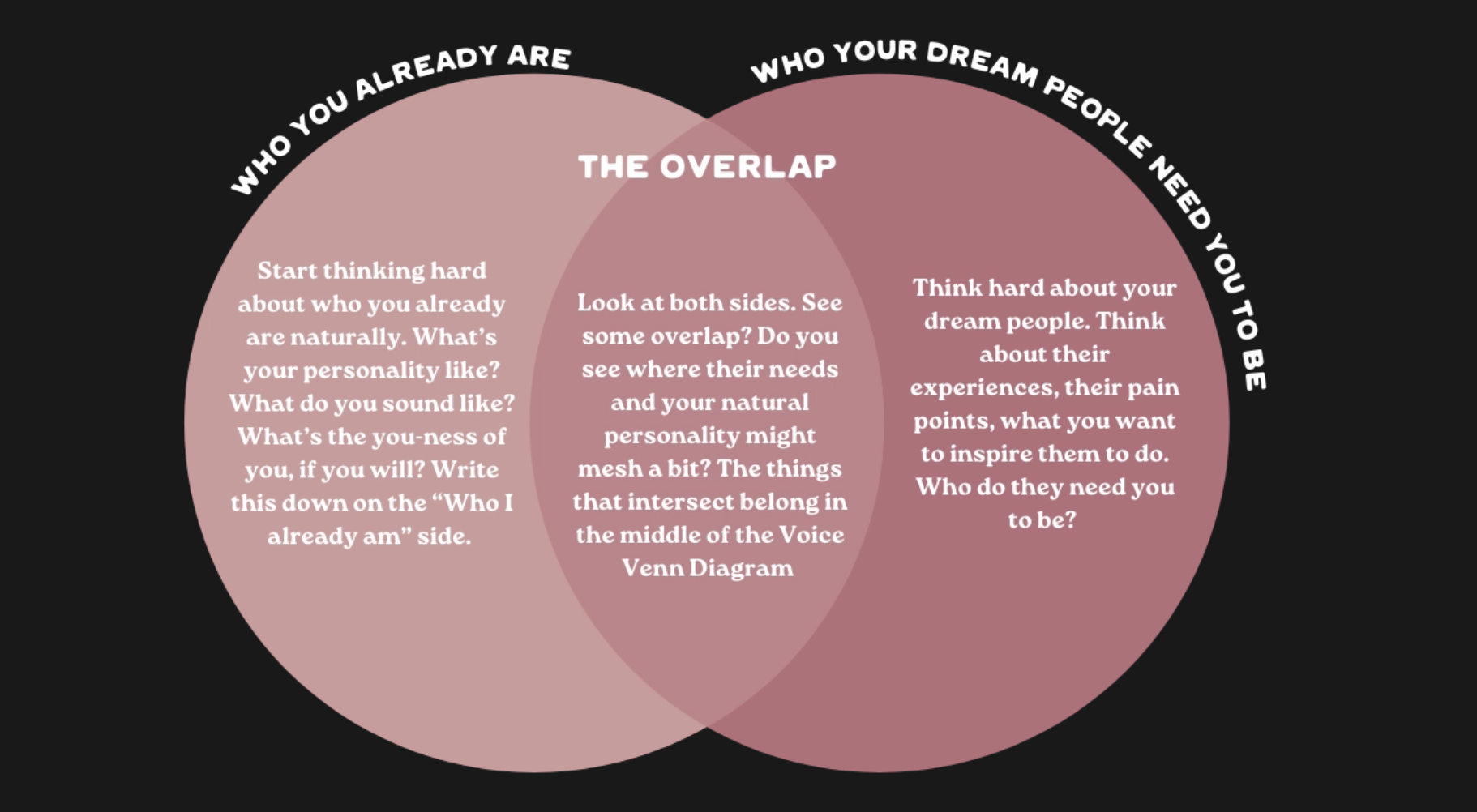
Think about it this way. I often describe myself as a copy pal instead of a copy pro. Why?
Because when I started thinking about my own brand voice, I realized something important. I'm naturally extroverted. I'm approachable. I'm conversational. I don't take myself too seriously.
At the same time, the people I want to work with are often intimidated by copywriting and marketing. They don't need me to be the smartest person in the room; they need me to be the least intimidating person in the room.
They need a pal who knows her copy stuff, not a copy pro who doesn’t care about being approachable. I found that in The Overlap.
Your overlap exists, too.
Your brand voice is important because people don't just buy from people.
People buy from people they like, they trust, they would get a beer with, and they would ally with on Survivor.
There's actually a sales psychology concept called the Liking Principle that essentially says people are more likely to trust you if they like you. And if they trust you, they’re more likely to buy from you.
The best way to get people to like you? Start by giving them the opportunity to like you by showing up with your sticky brand voice.
I always think of brand voice like it’s a neon welcome sign on a dark highway.
Imagine your dream customers driving down a dark road filled with dimly lit vacancy signs. Everything looks the same. Nothing stands out. They want to stop, but they can’t feel anyone out because every sign is sort of blah and sounds the same.
Then they see your sign. It's bright. It's memorable. It really speaks to and connects with them. Immediately, they decide they’re going to pull into your lot to get a feel for you.
That's what your brand voice does in a crowded online space – it helps the right people notice and remember you.
How to Do This On Your Own: Build a Brand Voice Dictionary
One of the easiest ways to start using your voice more consistently is to create what I call a Brand Voice Dictionary.
It's simply a go-to tip sheet for you when you’re writing – a living, breathing document where you collect your words, phrases, themes, jokes, and verbal quirks.
I’ve got a reel right here that teaches you step by step how to create yours, keep tabs on it, and use it!
Just make sure that you create the Dictionary somewhere you’ll actually use it (a note app on your phone, perhaps?) and then open it up every time you sit down to write.
Those little phrases become part of your vocabulary – and that’s what makes your voice memorable.
Consistency for the Copy Win: How to Write Better Copy Every Day
This is the least exciting advice I have, but it’s important – be consistent with your messaging and your brand voice.
Because all of this work is useless if you're not repeating yourself over and over.
And I know, consistency feels annoying. Every business owner eventually hits the point where they think, "If I talk about this one more time, people are going to lose their minds."
Meanwhile, someone who has followed you for three years is sitting there saying, "Wait, you launched a new collection?"
The reality is that people miss things, and they’re constantly being inundated with brand messaging, marketing, ads, and 5-second reels – all vying for their attention.
Which means you have to repeat yourself more than feels comfortable.
Your messaging needs to show up over and over again, your POVs need to show up over and over again, and your brand voice needs to show up over and over again.
Consistency is what makes you sticky.
The more consistently people hear your ideas in your voice, the more likely they are to remember you.
How to Do This On Your Own: Create Guides for Your Words
Think about how often you use your visual brand guidelines – You reference your logo, your fonts, your colors.
You wouldn’t dream of posting a graphic or updating your website or creating a new email signature without opening up your brand guidelines and using the colors, fonts, and logos you have for your brand, right?
Right. So…why aren't we doing the same thing with our words?
My best advice is to create shortcuts and guides you can open time and again to get that same consistency with your words!
Create a Messaging Guide, a Brand Voice Guide, and a Brand Voice Dictionary!
Give yourself resources you can open every single time you sit down to write. The easier it is to stay consistent, the more likely you'll actually do it. And consistency is what turns good copy into sticky copy! Here are a few quick resources for you to help you make your own guides!
Mini Messaging Marker: ($) A 12-minute training that gives you a hot jolt of inspo on what to say to sell or share about your stuff.
Brand Voice Basics (Free): A down ‘n’ dirty ebook that walks you through all the basics of curating and using your own brand voice!
How to Build Your Brand Voice Dictionary (Free): A quick and easy blog (or reel if you’re more of a visual learner) to teach you how to create and use your custom brand voice dictionary.
Brand Voice Bootcamp (Free):A weeklong email challenge that walks you through taking your brand voice from blaaaah to bold.
Brand Voice Roundup ($):A quick mini course that shows you step by step how to build and use your custom brand voice guide.
1:1 Brand Voice Strategy ($$):My signature done-for-you service where I curate your sticky brand voice, create your go-to Brand Voice Guide & Brand Voice Dictionary, then share an actionable checklist with step-by-step directions to show you how to use it every day.