Marketing Terms Explained: What Messaging, Copy, & Brand Voice Actually Mean
You know what I think the marketing industry is, like, insanely good at?
Taking perfectly simple ideas and wrapping them up in panic-attack-inducing buzzwords so you think you have to hire them in order to understand what’s going on in the marketing world.
Seriously. Words like messaging, brand voice, and key differentiators are designed to make you wig out so that you run to the copywriter near you and shout: Please! Let me hire you!
For a group of people whose entire job revolves around communication, we have done a truly terrible job communicating with normal humans.
Somewhere along the way, marketers collectively decided that "words for your business" sounded too approachable, so instead, we started throwing around words like copy, messaging, positioning, customer journey, conversion optimization, value proposition, and approximately 47 other terms that make business owners feel like they're failing a class they didn't know they signed up for.
I'm saying this as a copywriter. We’re guilty too.
The promise I’m making you is this: I’m here to de-scarify the marketing buzzwords to show you that you actually do know what’s going on out there in the spooky marketing world – we all just make it way harder than it needs to be.
Marketing Terms Explained: The Beginner’s Level Breakdown of Copy Buzzwords
I don’t talk about this very often, but I had a full-blown spiral somewhere around my third or fourth year as a copywriter because I could not, for the life of me, figure out what "messaging" actually meant.
Everywhere I looked, people were talking about messaging!
Strengthen your messaging. Refine your messaging. Just tweak your messaging strategy a lil bit.
And I remember sitting there wondering if I was somehow missing a secret piece of information everyone else had been given because what even is messaging? I knew the definition, sure, but I couldn’t figure out what in plain English – and in concrete terms! – it was.
And no one could tell me, either.
Spoiler alert: it's not complicated.
In fact, most marketing buzzwords aren't. The problem isn't that these concepts are difficult, it’s that our industry makes them sound difficult.
So, let's do this – let’s de-spookify some marketing vocabulary and translate it into normal-human language.
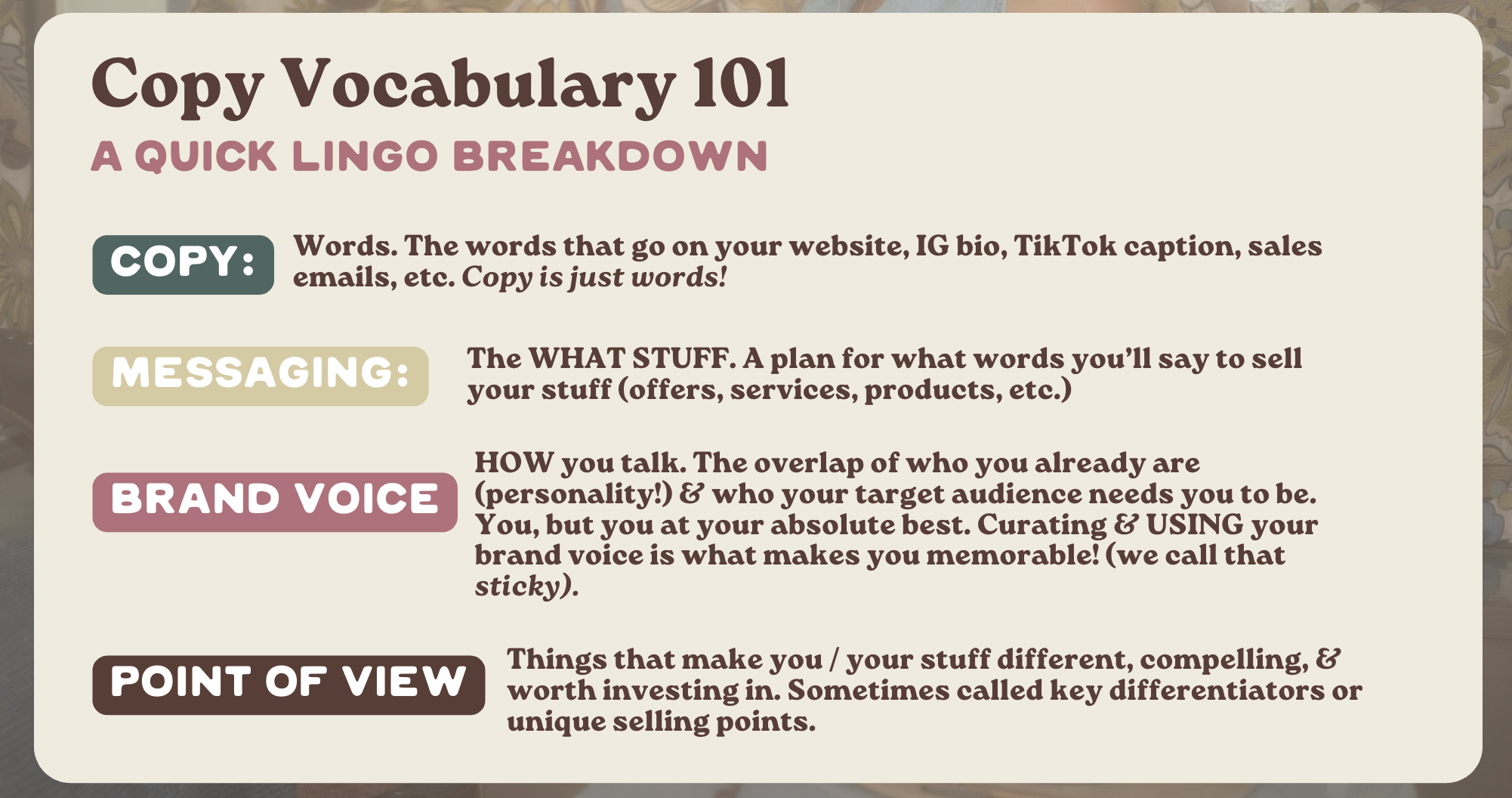
First Things First: What Is Copy?
Let's start with the big one – Copy. I’ve already said it, like, 25 times by this point, right?
When I say copy, I don't mean copyright law or copying someone else's work.
I literally just mean words – business words. The words on your website, on your Instagram bio, in your TikTok captions, in your sales emails, product descriptions, newsletter, sales page, about page…everywhere.
Copy just means the words your business uses to communicate. That’s it.
As a copywriter, all that really means is that I help people write the words for their businesses.
That's it. That's the whole job. When you strip away all the industry jargon, copy is just words!
Most business owners are already writing copy every single day (you are, you just didn’t know it).
My best advice for this: if the term copy freaks you out, just replace it with words.
Writing website copy freaks you out? Fine. Try writing words for your website. Much simpler, right?
What is Messaging?: It’s the What Stuff
Now let's talk about the word that personally victimized me years ago (I promise I won’t spiral again). Messaging.
Messaging is just the plan behind the words, or as I like to call it – The What Stuff.
If copy is the actual words, messaging is the plan behind the words.
Messaging is just deciding what you're going to say and who you’re going to say it to before you ever worry about how it's going to sound.
It’s the…
ideas you're trying to communicate
information you want people to understand
points you're trying to make
You get my drift, right?
Let's say you're launching a new offer. Before you ever sit down to write an Instagram caption or a sales page, you need to answer a few questions.
Who is this for?
What problem does it solve?
Why should someone care?
What makes it valuable?
What makes it different?
Those answers become your messaging.
Notice how none of that has anything to do with sounding clever? That’s because messaging doesn’t concern itself with how it sounds.
So What’s Sticky Brand Voice?: The How Stuff
Now that we've figured out what we're saying, we can talk about how we're saying it.
That's where brand voice comes in. If you’re not sure what brand voice is, I have a lot of blogs you absolutely must read:
But if you want the 101 version, your brand voice is your personality on paper.
It's how your business sounds when it talks! At Boundless, I define brand voice as the overlap between who you already are and who your people need you to be.
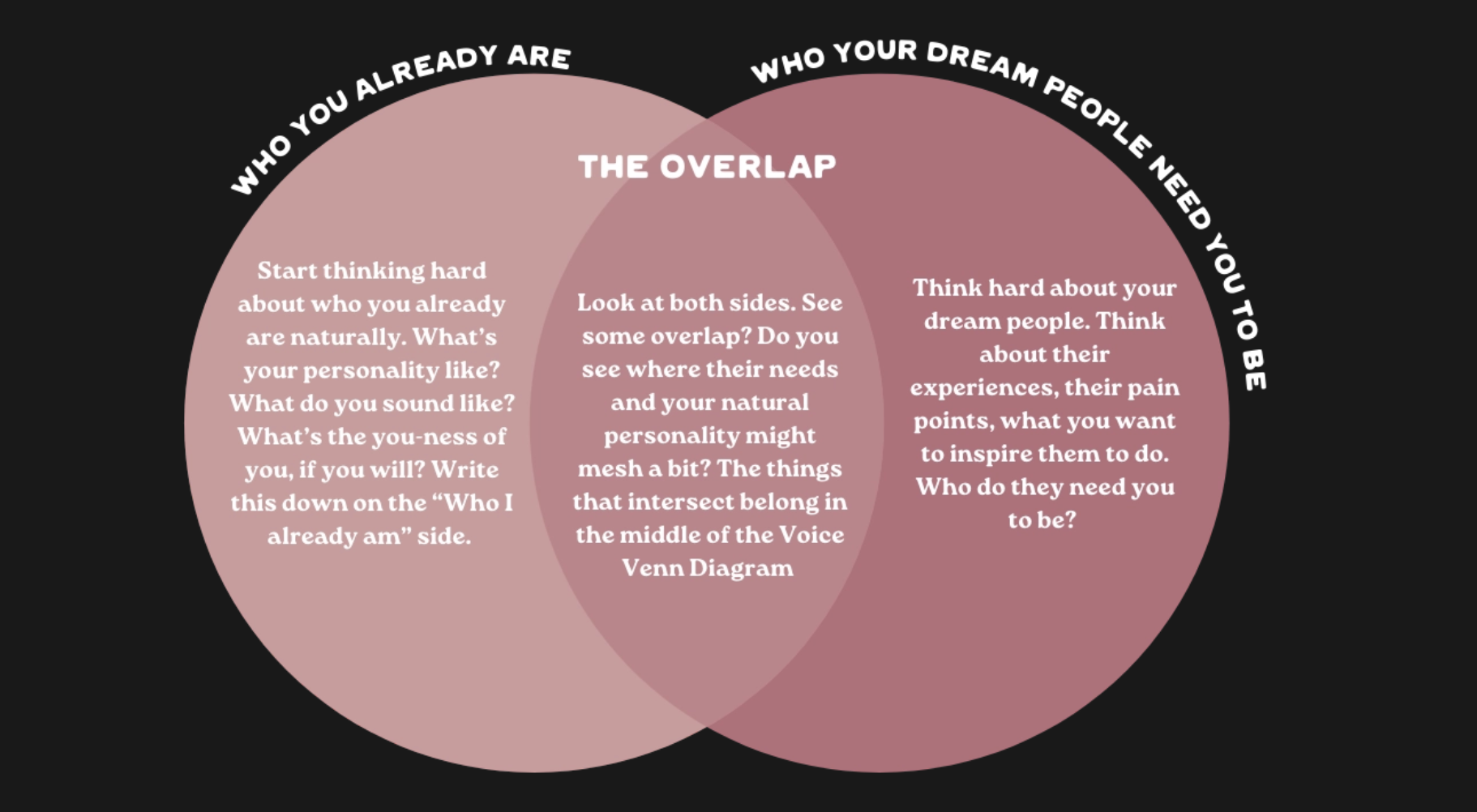
It's you, but you at your absolute best for the people you’re most excited to work with, meet, and share with.
For example, I'm naturally pretty extroverted. I'm conversational. I tell stories. I use weird examples. I call people "pal." Those things are already part of my personality.
At the same time, the people I most desperately want to work with are often overwhelmed by marketing and intimidated by copywriting and copywriters – they need an approachable friend.
The overlap between those two things became my brand voice.
I call myself a copy pal instead of a copy pro because that's the version of me my audience actually needs. Your overlap exists, too.
And once you find it, your goal is to use it consistently – because that’s what makes you memorable and sticky!
POVs: The Reason Someone Chooses You
The last marketing term I want you to make sure you know is POV.
POV stands for Points of View.
These are the things that make you, your offers, your products, or your services different, compelling, and worth investing in or paying attention to.
Sometimes these are called
Differentiators
Unique Selling Points
Unique Value Propositions
Your POVs are the things you'd say with your whole chest, they're the things you'd scream from a rooftop, and they're the things you'd blurt out if someone gave you thirty seconds to explain why your business matters.
Unfortunately, people don’t automatically know what makes you different all the time (they would in an ideal world). And we can’t really ask our people to know what makes us different, compelling, and worth investing in if we can’t even name those things ourselves.
That's asking a lot.
People need POVs to connect the dots on why you’re a good choice for them! And if you can really get to the heart of it all, those POVs are the things that will stick around in their brains – long after they’ve exited out of the sales page.
The fact is that you can't sell what you can't say, and your people can't hear what you're not telling them. Strong POVs are the dot connectors that stick with your people and make them say, “I’m interested…tell me more.”
You Already Know More Marketing Words Than You Think
Here's what I hope you take away from this: You don't need an MBA to understand marketing language.
And you definitely don't need to feel intimidated by words like messaging or brand voice just because they have a neat little, buzzword-y name.
Most of these concepts are things you're already doing naturally, you just didn’t know it.
So the next time a marketer starts throwing around scary-sounding buzzwords, take a deep breath.
Remember that…
Copy is just words
Messaging is just the what stuff
Brand voice is just how you say what you say
POVs are what make you different, compelling, and worth it.
See? So much less scary, right?
Need a Little Help? I’ve Got Your Back
If you’re struggling with what to say, try Mini Messaging Marker: ($) A 12-minute training that gives you a hot jolt of inspo on what to say to sell or share about your stuff. You can also chat with me for a 1:1 messaging strategy!
If you're struggling with how to say it and want some sticky brand voice help, try any of these bad boys:
Brand Voice Basics (Free): A down ‘n’ dirty ebook that walks you through all the basics of curating and using your own brand voice!
How to Build Your Brand Voice Dictionary (Free): A quick and easy blog (or reel if you’re more of a visual learner) to teach you how to create and use your custom brand voice dictionary.
Brand Voice Bootcamp (Free): A weeklong email challenge that walks you through taking your brand voice from blaaaah to bold.
Brand Voice Roundup ($): A quick mini course that shows you step by step how to build and use your custom brand voice guide.
1:1 Brand Voice Strategy ($$): My signature done-for-you service where I curate your sticky brand voice, create your go-to Brand Voice Guide & Brand Voice Dictionary, then share an actionable checklist with step-by-step directions to show you how to use it every day.